BISE Faisalabad 10th Class Result 2026
It has been a while since exams ended, and now there is one question on every student’s mind: when will the result come out? If you sat for your SSC Part 2 exam under BISE Faisalabad this year, whether you’re from Faisalabad city itself, Jhang, Toba Tek Singh, or Chiniot, you are not waiting alone. Thousands of students across this same board are going through the exact same wait right now.
This page brings together everything you need in one place. The expected result date, every checking method explained step by step, what to do if something on your marksheet looks wrong, and how rechecking and supplementary exams actually work. You shouldn’t need to search anywhere else after this.
Quick Answer: What You Need to Know Right Now
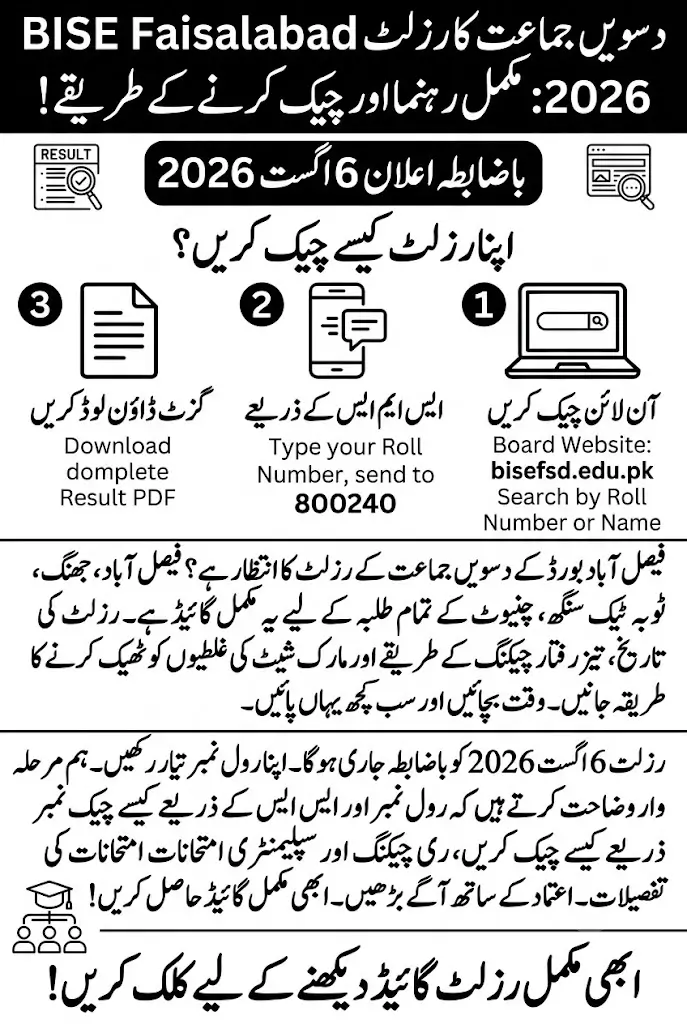
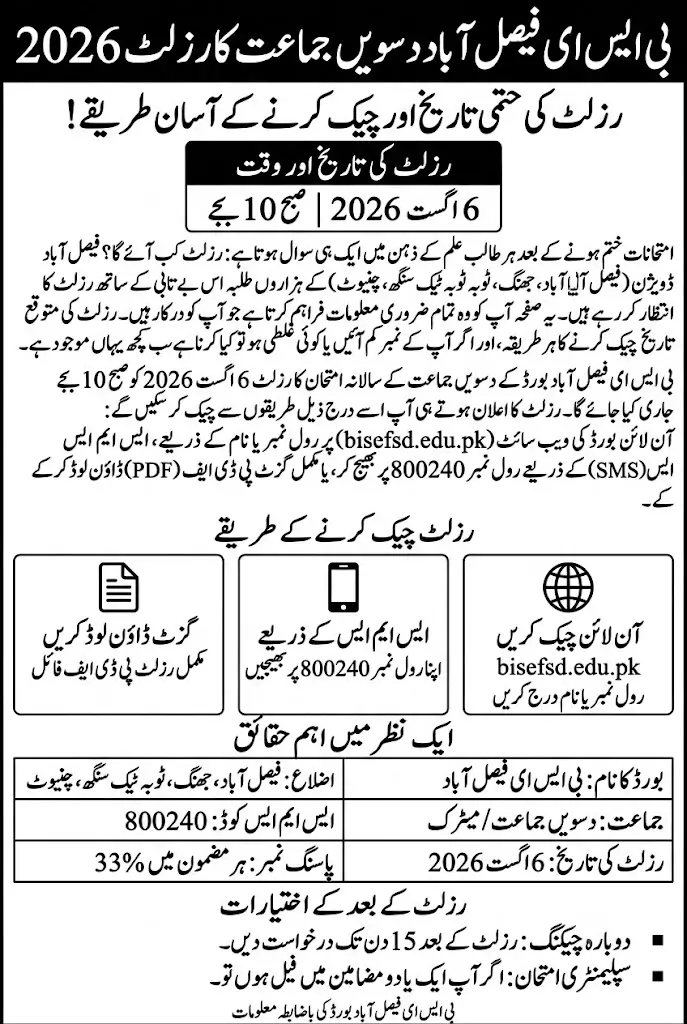
The BISE Faisalabad Board 10th Class Result 2026 is officially to be announced on 6 August 2026. Once announced, you will be able to check your result online by roll number, by name, through SMS on code 800240, or by downloading the official gazette PDF from bisefsd.edu.pk.
Key Facts at a Glance
Before getting into the step-by-step details, here’s a quick summary table covering everything important about this year’s result.
| Detail | Information |
|---|---|
| Board Name | Board of Intermediate & Secondary Education, Faisalabad |
| Year Established | 1988 |
| Districts Covered | Faisalabad, Jhang, Toba Tek Singh, Chiniot |
| Class | 10th Class / SSC Part 2 / Matric |
| Result Date | 6 August 2026 |
| SMS Shortcode | 800240 |
| Passing Requirement | 33% marks in each subject |
| Rechecking Deadline | 15 days from result announcement |
| Approximate Rechecking Fee | Around Rs 1,200 per subject |
| Official Website | bisefsd.edu.pk |
A Quick Introduction to BISE Faisalabad
Before diving into the checking process, it helps to know who’s actually behind this result. The Board of Intermediate and Secondary Education, Faisalabad, was established in 1988 to manage matric and intermediate examinations for the Faisalabad division. It covers four districts: Faisalabad itself, along with Jhang, Toba Tek Singh, and Chiniot.
Faisalabad happens to be the third most populated city in Pakistan, and this board handles one of the largest student populations among all Punjab boards every single year. That scale matters more than it might seem. It’s exactly why the result website tends to slow down so badly on result day, since it’s processing far more simultaneous traffic than a smaller board would ever see.
Each Punjab board, including Faisalabad, runs its own separate registration system, its own result portal, and its own specific rules for passing marks and rechecking. If your school is registered under BISE Faisalabad, everything about your academic record, from your roll number to your rechecking application, goes through this specific board office. Rules that apply in Lahore or Multan simply don’t carry over here.
When Will the Result Actually Be Announced?
This is naturally the question every student wants answered first. Right now, the Punjab Boards Committee of Chairmen (PBCC) has officially released the schedule: the BISE Faisalabad 10th Class Result 2026 will be announced on August 6, 2026, at 10:00 AM.
Here’s why the timeline takes this long in the first place. After your SSC Part 2 papers were collected in March, answer sheets had to travel from exam centers to subject examiners. Each paper gets marked, then cross-checked by board staff to catch any scoring or addition errors, and only after that does everything get compiled into the board’s final computerized record. This entire process naturally takes months rather than weeks, simply because accuracy has to come before speed.
Punjab’s nine boards, Lahore, Faisalabad, Multan, Gujranwala, Rawalpindi, Sargodha, Sahiwal, Bahawalpur, and DG Khan, coordinate their release timing through the Punjab Boards Committee of Chairmen, commonly known as the PBCC. This coordination exists so that college admissions across the province can begin around the same time for everyone, rather than one district’s students getting a head start over another’s.
Method One: Checking Your Result by Roll Number
This is, by far, the fastest and most reliable way to see your result the moment it’s live. Your roll number is a direct key to your specific exam record, with no risk of name-matching confusion.
Here’s exactly how to do it, step by step:
- Open your browser and type bisefsd.edu.pk directly. Avoid clicking on links shared through WhatsApp groups or social media, since some of these redirect to unofficial pages that occasionally display outdated or incorrect data.
- Look for the Matric Results section on the homepage. This tab usually stays inactive until the board officially releases the result, so don’t be alarmed if it looks empty a few days beforehand.
- Select the correct exam category, specifically 10th Class Annual 2026. Older years’ results often stay archived on the same page, so picking the wrong year will show you nothing useful.
- Type your roll number exactly as it’s printed on your original roll number slip. Every digit matters here.
- Click Search or Submit.
- Within seconds, your complete result should appear, showing subject-wise marks, your total score, and your final grade.
Here’s the thing most students overlook. Take five extra seconds before clicking submit to compare what you typed against your physical slip. A single wrong digit can either return an error message or, in rare cases, pull up an entirely different student’s record. Slowing down for a moment here saves a lot of unnecessary panic.
Method 2: Checking Your Result by SMS
Here’s the interesting part about result day. Within the very same hour that results go live, thousands of students across four districts try to open the same website at once. That kind of traffic slows any server down significantly, no matter how well-prepared the board is. SMS checking exists specifically to sidestep this entire problem, since it doesn’t rely on the website at all.
- Open the messaging app on your mobile phone.
- Start a new message.
- Type only your roll number as the entire message content. Don’t add any extra words, spaces, or symbols.
- Send this message to 800240, the official BISE Faisalabad result shortcode.
- Wait for a reply text. Within a few minutes, you should receive your total marks and result status.
SMS delivery itself can occasionally be delayed on result day, simply because millions of students nationwide send similar messages within the same narrow window. If you don’t get a reply within fifteen minutes, it’s most likely network congestion rather than any problem with your specific roll number. Sending the same message over and over again won’t help, it only adds to that congestion.
Method Three: Checking Your Result Through the Gazette PDF
A gazette is essentially the board’s master record, a single PDF file listing results for every student who appeared in that year’s exam. Schools and colleges rely on this document heavily, since it’s complete and doesn’t depend on the website staying fast.
- Visit the official website and go to the results section.
- Look for a file titled something like 10th Class Gazette 2026, which typically appears once results are officially announced.
- Download the file to your device.
- Open it using any standard PDF reader app.
- Press Ctrl + F on a computer, or use the search icon on your mobile device, to open the search function.
- Type your roll number or full name into the search box.
- The document will jump directly to your entry, showing your complete subject-wise result.
This method is especially useful for teachers or school administrators who need to check an entire class’s results at once, since scrolling through a single file is often faster than searching individual roll numbers on a slow website during peak traffic.
Faisalabad Board Grading System
Once your result is out, understanding what your percentage actually translates to matters just as much as seeing the number itself.
| Percentage | Grade | Remarks |
|---|---|---|
| 80% and above | A+ | Exceptional |
| 70 to 79% | A | Excellent |
| 60 to 69% | B | Good |
| 50 to 59% | C | Fair |
| 33 to 49% | D | Satisfactory |
| Below 33% | F | Fail |
BISE Faisalabad follows the standard requirement used across most Punjab boards: a minimum of 33% marks in each individual subject to pass. Here’s something worth knowing: if your overall marks look good, but you score below 33% in even one single subject, your entire result gets placed in compartment status. That’s exactly why it’s worth checking every subject on your marksheet individually, not just glancing at your total score.
What to Do If Your Marksheet Shows Wrong Information
Occasionally, a result appears with a spelling mistake, a missing subject, or a total that doesn’t match what a student expected. Each situation has a specific, established fix, and it helps to know which one applies to you before you panic.
If your name or your father’s name is misspelled, this is generally a data entry issue from the registration stage, not an exam-related problem. Report it to your school immediately, since they need to submit a formal correction request to the board office along with your original registration documents. Individual students typically cannot resolve this kind of issue on their own.
If an entire subject is missing from your marksheet, this points to an administrative registration issue rather than anything related to your actual exam performance. This also needs to be raised through your school for the same reason.
If your total marks seem lower than expected, purely because of what feels like an addition or transcription error, this is exactly what the rechecking process exists for. Applying within the fifteen-day window is your correct next step, and this is one thing you’re allowed to apply for personally.
Throughout this entire process, keep your original admit card, roll number slip, and registration documents safe. You’ll need them for any correction request or rechecking application.
How Rechecking Actually Works
A lot of students assume rechecking means an examiner sits down and re-reads their written answers with fresh eyes. It doesn’t work that way at all. Rechecking exists for one narrow purpose: verifying that your marks were added correctly and transferred accurately from your original answer sheet onto the final computerized marksheet.
Here’s the complete process, step by step:
- Visit the official BISE Faisalabad website within fifteen days of the result announcement. Applications submitted after this window are generally not accepted.
- Download the rechecking application form from the results or downloads section.
- Fill in your personal details carefully, full name, roll number, registration number, and the exact subject or subjects you want rechecked.
- Generate the fee challan for rechecking and confirm the current amount printed on it, since fees are occasionally revised. The typical rechecking fee across Punjab boards is around Rs 1,200 per subject.
- Deposit the required fee at the bank branch specified on the challan.
- Attach the paid challan to your completed application form.
- Submit the combined package either directly at the BISE Faisalabad examination office or through your school administration.
- Keep a personal copy of both the submitted form and the paid challan for future reference.
Honestly, most rechecking applications come back with the original result unchanged, since the board’s initial checking process is fairly thorough already. But when a genuine addition or transcription error does exist, an updated result card is issued reflecting the correction. Outcomes typically arrive within a few weeks of submission.
What Happens If You’re Fail In One or Two Subjects
Failing one or two subjects out of your entire exam doesn’t mean repeating the whole academic year. BISE Faisalabad runs a supplementary exam, also known as the second annual exam, specifically for students in this situation, formally called compartment status.
- Confirm your eligibility: this exam applies to students who failed only one or two subjects while clearing the rest.
- Wait for the supplementary admission form to become available on the official website, usually within fifteen days of the annual result.
- Download the form and fill in your personal details along with the exact subjects you need to reappear in.
- Pay the prescribed fee at the bank branch mentioned on the form.
- Attach the paid challan to your completed admission form.
- Submit the form through your school if you’re currently enrolled, or directly through the board office if you’re a private candidate.
- Wait for your roll number slip for the supplementary exam, usually issued a few weeks before the exam date.
Passing this supplementary exam updates your overall matric result to a complete pass, allowing you to move forward into eleventh class admission without losing an entire academic year.
Frequently Asked Questions
When is the BISE Faisalabad 10th Class Result 2026 expected to be announced?
The 10th class result is officially announcing on 6 august 2026.
What is the SMS shortcode for BISE Faisalabad?
800240 is the official code. Send only your roll number as the message content to receive your result by text.
What is the minimum passing percentage for BISE Faisalabad? Students need at least 33% marks in each individual subject to pass, in line with the standard used across most Punjab boards.
How can I check my result if the website isn’t loading?
Switch to the SMS method by texting your roll number to 800240, or download the official result gazette PDF instead.
Why does my roll number show “no record found”?
This is almost always caused by a typing mistake. Recheck every digit carefully against your original slip before assuming there’s a genuine system error.
How long do I have to apply for rechecking?
You must apply within fifteen days of the result announcement, since applications submitted after this window are generally not accepted.
How much does rechecking cost?
The fee is typically around Rs 1,200 per subject, payable through a bank challan attached to your application form.
Does rechecking guarantee my marks will increase?
No. Rechecking only confirms whether your marks were added and transferred correctly. If no error is found, your original result remains unchanged.
Which districts fall under BISE Faisalabad?
Faisalabad, Jhang, Toba Tek Singh, and Chiniot.
Will I receive my original certificate immediately after checking my result online?
No. The result you see online is a provisional marksheet. Your original detailed marks certificate is issued later through your school in physical form.
Final Thought
Whatever your result shows once it’s announced, there’s a clear, established process for every possible outcome. Correction requests exist for wrong personal details, rechecking exists for genuine marks-related concerns, and supplementary exams exist for anyone needing a second attempt at specific subjects. Faisalabad’s board handles one of Punjab’s largest student populations every year, so a little patience on result day genuinely goes a long way. Check your result only through official channels, keep your documents organized, and move forward into your next academic step with confidence.